Ever wondered what your weight truly means for your health? This comprehensive guide demystifies Body Mass Index (BMI), explaining how to calculate it, interpret the results, and understand its limitations. We'll explore alternative methods for assessing body composition and provide actionable advice for both individuals and healthcare professionals. For more on measuring obesity, check out this helpful resource: Obesity Measurement.
Calculating Your BMI: A Step-by-Step Guide
BMI is a simple ratio of weight to height, providing a general indication of whether your weight is in a healthy range. However, it's crucial to remember that BMI is just one piece of the health puzzle.
Step 1: Determine Your Weight: Weigh yourself using a scale, recording your weight in kilograms (kg). If your scale displays pounds (lbs), use an online converter or the conversion factor of 1 kg ≈ 2.2 lbs.
Step 2: Measure Your Height: Measure your height in meters (m) using a measuring tape. Online tools can easily convert feet and inches to meters.
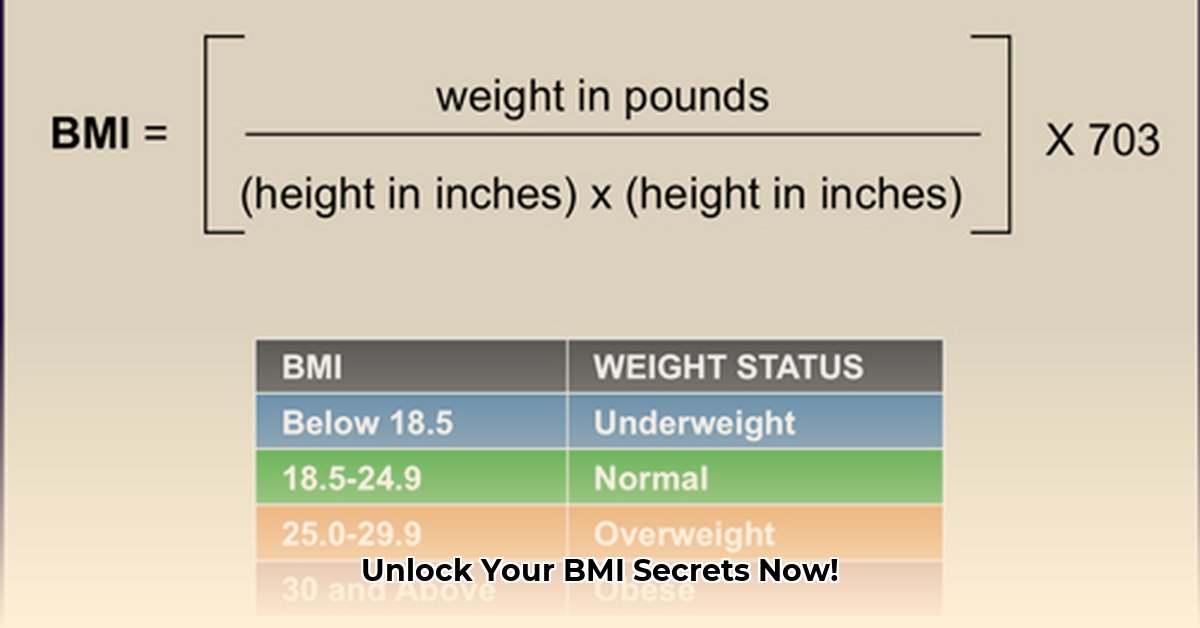
Step 3: Calculate Your BMI: Use the following formula: BMI = weight (kg) / [height (m)]²
Example: A person weighing 70 kg and measuring 1.75 m tall would have a BMI of 70 / (1.75)² = 22.86.
Step 4: Interpret Your BMI: Use the following categories as a general guideline:
| BMI Range | Category |
|---|---|
| Below 18.5 | Underweight |
| 18.5 - 24.9 | Normal Weight |
| 25.0 - 29.9 | Overweight |
| 30.0 and Above | Obese |
Is your BMI within the healthy range? If not, don't panic! Remember, this is just one factor impacting overall health.
Understanding the Limitations of BMI
While convenient, BMI has significant limitations. It doesn't differentiate between muscle mass and fat. A muscular individual might have a high BMI despite being perfectly healthy. "BMI doesn't account for age, gender, ethnicity, or body fat distribution," explains Dr. Anya Sharma, MD, Professor of Endocrinology, University of California, San Francisco. It's a snapshot, not a complete picture of your health.
Beyond BMI: A Holistic Approach to Health Assessment
For a more comprehensive assessment, consider these additional factors:
Waist Circumference: Excessive abdominal fat, indicated by a large waist circumference, increases the risk of several health problems.
Body Fat Percentage: This more accurately reflects body composition, differentiating between fat and lean mass. Methods such as DEXA scans or bioelectrical impedance analysis (BIA) can determine body fat percentage. (DEXA scans use X-rays to assess bone density and body composition, while BIA uses a small electrical current to estimate body water and fat content.)
Blood Pressure and Cholesterol Levels: These are crucial indicators of cardiovascular health, often linked to weight.
Family History: Genetic predisposition to certain health conditions, such as diabetes or heart disease, should be considered. "Family history is a significant risk factor, often overlooked," adds Dr. David Lee, PhD, Professor of Genetics, Stanford University.
Lifestyle Factors: Diet, exercise, sleep, and stress management all play pivotal roles in overall health and well-being.
Interpreting Your Results: A Balanced Perspective
Your BMI, combined with other health indicators and lifestyle factors, should be interpreted by a healthcare professional. They can provide personalized advice based on your individual circumstances. A high BMI increases the risk of certain conditions, but it's not a definitive predictor. Conversely, a low BMI doesn't guarantee good health.
Practical Advice for Accurate BMI Interpretation
- Use BMI as a screening tool: It helps identify potential risks, but further assessment is necessary.
- Consult a healthcare professional: They can offer personalized guidance based on your individual health profile.
- Focus on holistic health: Prioritize healthy eating, regular exercise, and stress management for overall well-being.
- Don't overemphasize the number: BMI is just one piece of the larger health picture.
Remember, your health is a complex interplay of various factors. Use BMI responsibly, alongside other assessments & lifestyle considerations, for a balanced view of your well-being. Consult your doctor for personalized advice.